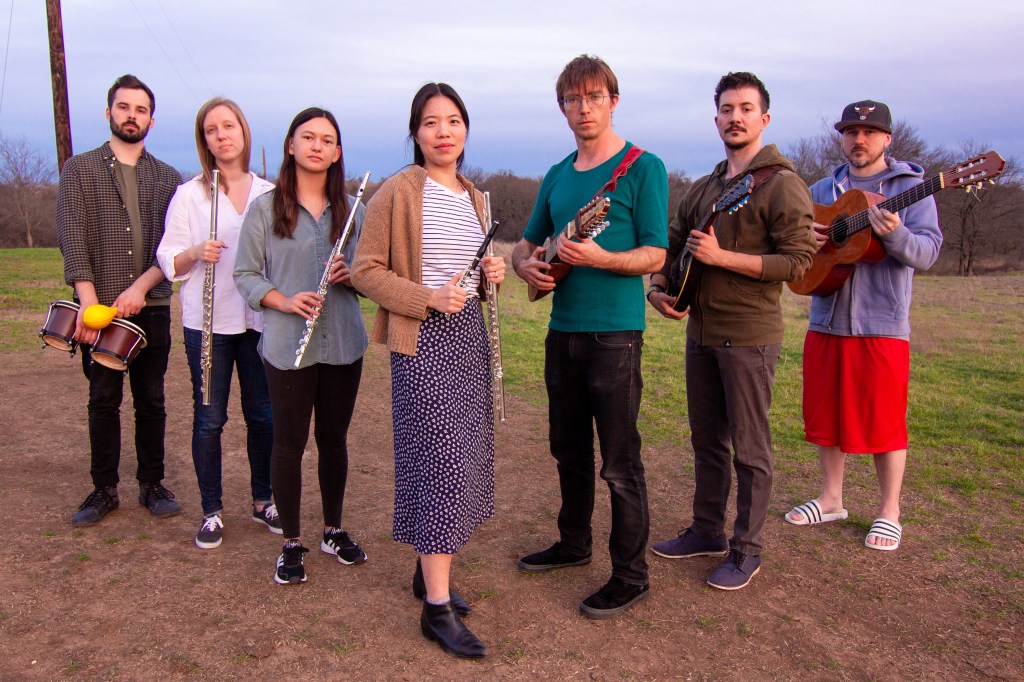
The Pan-Tones
Alyse Hokamp- flute, piano, piccolo, vocals, arrangement
Robert Hokamp- guitar, bass, charango, arrangement
Natasha Costello- flute, piccolo, keyboard
Jessica Schury- flute, alto flute
Connor Kent- drums and percussion
Special guests
Jesse Coulter- guitar, bass
Thane Isaac- violin, mandolin
***Click on the song title to hear the original version. The full YouTube playlist of all our music is here.
The Pan-Tones
Kacharpari (Quechua: “send away” or “goodbye”)- Andean folk
Based on recordings by Los Incas (re-released on a 2002 compilation) and Los Caballeros (1974).
More about the band Los Incas (aka Urubamba) here, which was directed by the Argentinian composer and world-renowned charanguista Jorge Milchberg (1928-2002).
Sinfonia No. 40– Andean folk
By Los Laikas, based on themes from Mozart’s Symphony No. 40. From their album Los Laikas 3 (1973).
The Pan-Tones + Jesse Coulter
Guadalquivir– (one of Spain’s most important rivers)- Andean folk
Based on the recording by Los Caballeros (1974).
Alyse: This is a tune I originally arranged in 2015, when I joined Los Patos Poderosos (Peruvian chicha/cumbia band).
Ratita (Little Mouse) – Carnivalito (Carnival Dance from Deni and Sta. Cruz)
From the album “Folklore de Bolivia, Vol. 2” (1994) by Ukamau, led by Hery Cortes.
“In contrast to the original music of the Indians, stringed instruments dominate the musica criolla which developed under the recordings and rearrangements of European influence. Amongst these are the Carnival songs in which the ability of the Indians to inspire and their joy of life are reflected.”*
In the original version, it is being played Zampoñas, a reed pipe, known in Europe as panflute. Since it takes time to physically move from one pipe to the next, the melody is split between two players to create a continuous musical line (and awesome stereo effect!).
Concierto para Ritmo (Concerto for rhythm)- Peruvian chicha
From the Los Destellos album “Sicodélicos” (1968). Another tune Los Patos started playing in 2015.
El Gran Boneton (The big hat)- Peruvian chicha
From the Los Destellos album “Clase… aparte” (1971).
The Pan-Tones
Abendsegen (Evening prayer) and Knusperwalzer (Crispy waltz), from the opera Hansel and Gretel (1893)
By German composer Engelbert Humperdinck (1854-1921).
Alyse: I subbed in a rehearsal and performance with The Dallas Opera’s last fall, and loved the music.
Flute trio
Opening, Palette Town Theme, Battle (vs. Trainer), Pokémon Center, from the Pokémon video game soundtrack (game released 1996)
By Junichi Masuda (b. 1968).
Alyse: I saved up for a (b&w) gameboy in 6th grade, and the Pokémon Blue game was one of the few games I had. These are tunes I remember from that time, and I believe some of them are still used in the current game.
Alyse, Robert, Connor
Libertango (1974)
By Argentinian composer Astor Piazzolla (1921-1992), arr. Klaus Jäckle.
The Pan-Tones
Lamentos– Brazilian choro
By Pixinguinha (1897-1973), a saxophonist and flutist, and one of the most important choro composers.
Robert: For this arrangement, I transcribed the guitar and melody line from the version by Orquestra Brasília from their 1989 album Pixinguinha. I added flute and alto flute harmony parts and Connor added percussion.
Alyse: Thanks to Connor for introducing us to choro, when he heard the first incarnation of The Pan-Tones!
Merry-Go-Round of Life (人生のメリーゴーランド)
By Joe Hisaishi (b. 1950), from the 2004 Studio Ghibli animated film “Howl’s Moving Castle.”
Alyse: I grew up as a Japanese American in Hawai’i, which has a very large Japanese-American population, and lots of Japanese tourists. Studio Ghibli films are very popular there, and I loved this movie, especially Howl’s capricious yet charming character.
Alyse, Robert, Thane, Connor
Proezas do Solon– Brazilian choro
Another lively tune by Pixinguinha and Benedito Lacerda (1903-1958), Brazilian flutist, composer, and conductor.
The Pan-Tones + Thane
O Gato e o Canario (The cat and the canary)- Brazilian choro
By Pixinguinha and Benedito Lacerda.
***Break***
The Pan-Tones
By Youmi Kimura, Japanese singer and lyre player. This was the closing theme song for the 2001 Studio Ghibli film “Spirited Away.”
Alyse: This is possibly my favorite movie ever!
By Tetsuya Komoro (b. 1967), the theme song to the Japanese animated TV show Sailor Moon.
Alyse: I remember watching this show on Cartoon Network when I was growing up.
The Pan-Tones + Jesse
Potokito– Huayno (Bolivia)
-Citizens of Potosi (Old Quechua dance)
By Ukamau
Dominguitos– Danza-Huayno
-Sunday (Dance of the Chapacos, i.e. farmers of the region of Tarija, South Bolivia)
Also by Ukamau
Robert: Hery Cortes’s solo in this song is the reason I started playing the charango (based on the European guitar and mandolin, this ten-stringed instrument has a body made from the armour of the armadillo).
Busco tu Amor (I seek your love) Peruvian chicha
By Grupo Naranja, 1979.
Thane, Robert, Connor
Flamengo– Brazilian choro
By Jacob do Bandolim (1918-1969), Brazilian musician, composer, and mandolinist of the choro genre, 1948.
Thane, Alyse, Robert, Jesse, Connor
Samba do Urubu (Samba of the Vulture) – Brazilian choro
By Pixinguinha.
In our arrangement, we split the virtuosic through-composed flute melody between violin and flute.
The Pan-Tones + Thane
Naquele Tempo (In that time) Brazilian choro
By Pixinguinha and Benedito Lacerda, 1946.
The Pan-Tones
By Krzysztof Komeda (1931-1969), Polish film composer and jazz pianist. This is the opening theme from the 1968 horror film Rosemary’s Baby.
Tosca medley: Mario! Mario! Mario! …Son qui, Qual occhio al mondo, Mia gelosa
Melodies from Giacomo Puccini’s (1858-1924) Italian opera, Tosca (1900).
Alyse: I fell in love with these melodies while playing for The Dallas Opera’s Hart Institute for Women Conductors in January. While singing the first melody to myself, I started to hear the triplet accompaniment as a 6/8 ballad, and that was the seed of inspiration for this arrangement.
Segura ele– Brazilian choro
By Pixinguinha.
Everybody
El Cóndor Pasa– Andean folk
By Daniel Alomia Robles (1871-1942). Based on recordings by Los Incas (1963) and Los Caballeros (1974).
The tune was originally a musical piece in the Peruvian zarzuela (musical play), El cóndor pasa. Full Wiki article here.
Unaimanta– Aire Andino
-In other Times (Dance of the Andes’ Aymaras)
Traditional (Bolivia)
“…the ancient tunes of the Aymaras did not yet know song. Their music was simple and abstract. Involuntarily one is reminded of the wind, or the majesty spaces of the high plateaux.”*
*from the liner notes to Folklore de Bolivia vol. 2

 Alyse Hokamp