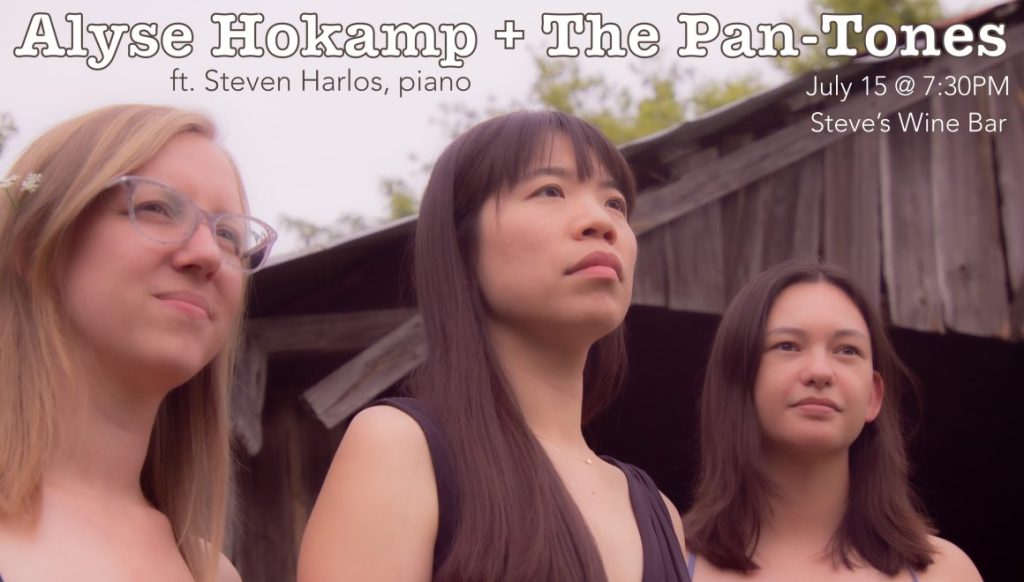
Flute recital
Keep up with me on social media:
This program was inspired by my experience playing with The Dallas Opera orchestra this year. I fell in love with the music, the drama, and the stories.
Alyse Hokamp, flute
Steven Harlos, piano
Robert Hokamp, guitar
Jessica Schury, flute
Gaetano Donizetti, Sonata
Donizetti (1797-1848) composed over 70 operas, the most famous being L’elisir d’amore (The Elixir of Love), and Lucia di Lammermoor (with the famous mad scene/flute cadenza).
Alyse: I had the opportunity to sub last minute for a rehearsal of L’elisir d’amore with The Dallas Opera last fall. I really liked some of the arias, especially Quanto é bella, quanto é cara (which I arranged for steel guitar), and Una furtiva lagrima.
Domenico Cimarosa, Concerto in G Major for 2 flutes (ft. Jessica Schury)
Cimarosa (1749-1801) composed over 80 operas, although they are not frequently performed today.
Alyse: I didn’t realize Cimarosa had composed operas, but came across this piece in researching music for my recital. I recognized it immediately from a Rampal album I had been gifted from my flute teacher in high school. I didn’t have many CDs at the time, so the ones I had were played on repeat. When I heard the melodies again, they seemed operatic to me- very catchy and singable. Then, I read the obligatory Wikipedia article and realized he was a prolific composer of opera.
Wolfgang Amadeus Mozart, arr. Alberto Vingiano, arias from Don Giovanni (ft. Robert Hokamp)
Madamina, il catalogo è questo is sung by Leporello, Don Giovanni’s servant. He is describing his master’s numerous and diverse “conquests.” Read the lyrics and translation here.
Là ci darem la mano is sung by Don Giovanni and Zerlina, a peasant girl already engaged to Masetto. DG is attempting to seduce Zerlina… Read the lyrics and translation here.
Mozart (1756-1791) hardly needs an introduction, being a prolific composer of symphonic, choral, chamber, and opera music.
Alyse: I had the opportunity to perform several arias from Don Giovanni in January with TDO’s Hart Institute for Women Conductors. I didn’t recognize it immediately, but when I researched the opera, I realized Là ci darem la mano, which I did know, was from this opera. I remember liking that aria back when I performed the (entire) opera as a student at UNT, probably about 10 years ago.
Don’t miss The Pan-Tones’ arrangement of Mozart’s Symphony No. 40 in the second half! 🙂
Charles Gounod, Concertino
French composer Charles Gounod (1818-1893) composed 12 operas, the most popular being Faust and Roméo et Juliette (to be performed next year at The Dallas Opera!).
Alyse: This piece is completely new to me!
Georges Bizet, arr. François Borne, Carmen Fantasie Brillante
Bizet (1838-1875) composed 18 operas, Carmen being the final one. Gounod attended the premiere, and according to one account, accused Bizet of plagiarism: “Georges has robbed me! Take the Spanish airs and mine out of the score and there remains nothing to Bizet’s credit but the sauce that masks the fish.”
Alyse: This set of themes and variations is an iconic showpiece for the flute. I first performed it in high school, probably my junior or senior year, which is nearly 18-19 years ago now! At the time it was very challenging, and I had to practice it a lot. But it’s pretty amazing how memory works- a lot of it stuck with me, so it was very quick to memorize, despite the quantity of notes.
The Pan-Tones
Keep up with us on social media:
Alyse Hokamp
Robert Hokamp
Natasha Costello
Jesse Coulter
Thane Isaac
Connor Kent
Jessica Schury
All arrangements by Alyse (A) and Robert (R) Hokamp.
Ratita (R)
“Little Mouse” – Carnivalito (Carnival Dance from Deni and Sta. Cruz), Bolivian folk music. From the album “Folklore de Bolivia, Vol. 2” (1994) by Ukamau, led by Hery Cortes.
*In the original version, it is being played Zampoñas, a reed pipe, known in Europe as panflute. Since it takes time to physically move from one pipe to the next, the melody is split between two players to create a continuous musical line.
Dominguitos (R)
“Sunday” – Danza-Huayno (Dance of the Chapacos, i.e. farmers of the region of Tarija, South Bolivia), also by Ukamau.
Sinfonia No. 40 (A)
By Los Laikas, based on themes from Mozart’s Symphony No. 40. From their album Los Laikas 3 (1973).
Sailor Moon theme song: Moonlight Legend (ムンライト伝説) (A)
By Tetsuya Komoro (b. 1967), the theme song to the Japanese animated TV show Sailor Moon.
Alyse: I remember watching this show on Cartoon Network when I was growing up.
Proezas do Solon (R)
Brazilian choro.
By Pixinguinha and Benedito Lacerda (1903-1958), Brazilian flutist, composer, and conductor.
Naquele Tempo (R)
“In that time” – Brazilian choro
By Pixinguinha and Benedito Lacerda, 1946.
O Gato e o Canario (R)
“The cat and the canary”- Brazilian choro.
By Pixinguinha and Benedito Lacerda.
Serbian Dance (R)
By Boban Prodanovic.
Unaimanta (R)
“In other Times” (Dance of the Andes’ Aymaras), traditional music from Bolivia.
Kacharpari (A)
Based on recordings by Los Incas (re-released on a 2002 compilation) and Los Caballeros (1974).More about the band Los Incas (aka Urubamba) here, which was directed by the Argentinian composer and world-renowned charanguista Jorge Milchberg (1928-2002).
Ti Amo (A)
Song by Umberto Tozzi, 1977.
Alyse: In exploring the world of opera, I got tired of having to translate every time I wanted to know what the words were saying, so I started studying Italian a few months ago. One morning, I was struck by curiosity about Italian pop music, and “discovered” this song, which was a major hit.
I like how the song is so simple and repetitive- very groovy, very different than classical music. Throughout the song, the texture changes with each verse. It feels like looking through a kaleidoscope where the colors stay the same, but get rearranged and seen from different angles, and in different shapes.
I also arranged this for myself playing accordion with drum track here.
Romance Cumbia (R)
A very famous piece, usually performed by solo classical guitar.
The melody has appeared in many arrangements, in many countries, often with added lyrics. Read more about this piece here.

 Alyse Hokamp