Recently, I’ve been thinking about the first time I played for The Dallas Opera in the banda for Rigoletto, which was exactly a year ago. It was my first professional orchestral work, so a pretty huge deal for me! Playing in an orchestra had been a dream/fantasy for so long, and I honestly wasn’t sure it would ever become my reality.
For Rigoletto, I prepared as best as I knew how, but knowing what I know now, it seems almost minimal.
One of the things I love about opera is the sort of friendly competition to know the opera as deeply as possible. There are so many layers- the music, the vocal parts, the words, the characters, the story, and the sheer length of the work. I understand now that depth of knowledge comes from studying operas repeatedly throughout a career, each time becoming more intimate with it. There’s always more to discover.
#1 Rigoletto- banda piccolo
The banda plays immediately after the Prelude, and is finished within the first 10 minutes of the opera.
My preparation:
-Listened to the first 10-15 minutes of the opera on repeat
-Played along with the recording (building confidence with entrances, phrasing)
-Worked on piccolo fundamentals
-Practiced my part

At the rehearsals, I was able to play my part well, nail the entrances, and fit within the ensemble.
What I didn’t do:
-Listen and practice with the full score
-Learn the other flute parts
-Learn the entire opera
-Read the libretto
In retrospect, I should have taken the opportunity to study the entire opera and learn the other flute parts. What I didn’t yet perceive is that if there had been a need for a sub, I might have been asked. Also, Rigoletto is an important work of the opera repertoire that includes some very famous arias.
It was with Rigoletto that I really fell in love with opera. I’d played a couple of operas in college, and enjoyed them, but this struck me on a different level. I adored the music, the singing, the visual elements, and being backstage. It was exciting, and also nostalgic of the many ballet productions I performed growing up.
#2 Hansel and Gretel- piccolo
Hansel and Gretel taught me A LOT about preparation. The dedicated piccolo part has long stretches of rest, and some of them are unspecified. In the image below, you can see that it would be easy to get lost between rehearsal numbers 30 and 45… especially if you happen to be rehearsing without singers (which we were!).
On top of that, H&G is a through-composed opera, so there aren’t stops, or different “numbers” like there are in Mozart and other earlier operas. Meaning, if you happened to get really lost, you could be screwed for a very long time…
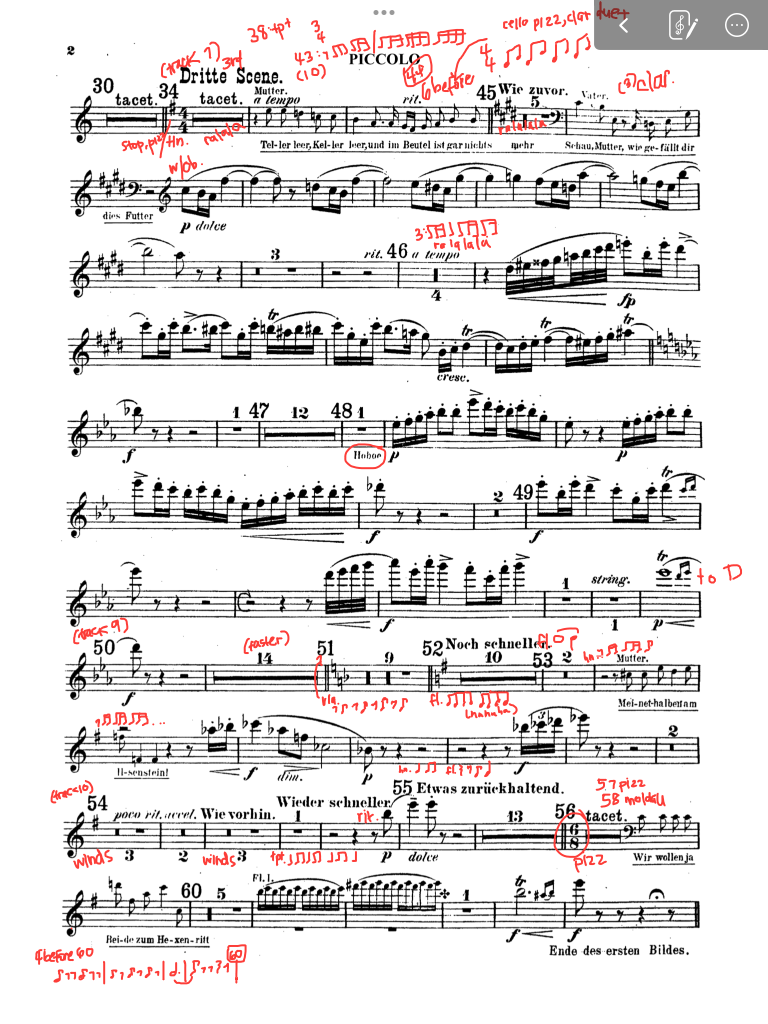
I was scheduled to sub for rehearsal the day after the final Rigoletto performance- a long day of two 3 hour rehearsals. When I realized what I was working with, I pretty quickly came to understand that the only way for me to not be miserably anxious for those 6 hours was to learn the entire opera.
My preparation:
-Listen to the full opera 2x
-Play through the opera with the full score
-Make a ton of notes in my part
With H&G, I started to understand that there are strong traditions in how arias are performed, and that phrasing and taking time will frequently occur in spots that may or may not indicated in the score.
I learned to use the different melodic material as cues for the way the music was organized, and listen for “landmarks” in the music that would orient me in a particular section.
As I described in this post, I really thanked myself for my somewhat neurotic preparation when I was called at the last minute two weeks later to sub on a performance!
What I didn’t do:
-Learn the other flute parts
-Study the vocal score
-Read the libretto
I hadn’t yet discovered the vocal score (piano reduction of the opera used for rehearsals), or read the full libretto, though I did read the synopsis.
#3 L’elisir d’amore- 2nd flute/piccolo
Another last minute call, and I had not acquainted myself with this opera prior to the ~24 hour call to sub for a double rehearsal of TDO’s educational version of Donizetti’s opera.
The good news is that for this opera, the two flute parts are printed on the same part, so I could easily follow along.

My preparation:
-Listen through the entire opera
-Mark in cues
-Practice the part (a little)
By this point, I knew I needed to focus on entrances, how the part fit with the orchestra, tempos, and phrasing/style. My time was very limited, so I didn’t have time to practice the part much.
What I didn’t do:
-I didn’t anticipate that I would be called for this opera. I think I was somewhat aware of the TDO calendar, but hadn’t taken it upon myself to study Elixir.
#4 Das Rheingold- flute 2
By this point, I caught on to the fact that I could be summoned for any opera at the last minute. I knew I wanted to be able to say yes, and be confident that I could do a good job playing my part. So I had already started practicing Rheingold a little, though not too seriously, before I was asked to sub on a rehearsal. In this instance, I had a couple of weeks notice before the rehearsal.
Wagner is also through-composed, and significantly longer than H&G. However, the flute parts are less prominent, and included more instrumental cues, which are much more helpful than vocal cues (especially when rehearsing without singers).
My preparation:
-Listen the the entire opera
-Play Fl 1 part with the full score- I realized if I learned this part, it was really helpful for me to orient the Fl 2 part, because Fl 1 plays more and is very reliable for cues (since it’s impossible to miss).
-Play Fl 2 with score and part
#5 Hart Institute- flute 2
I had about 6 weeks to prepare selections from Don Giovanni, Carmen, Tosca, and Dead Man Walking. My preparation for this was happening at the same time as the Rheingold rehearsal, so I basically had a ton of music to learn all at once.
I prepared in more or less the same way as the Rheingold rehearsal.
This was my first scheduled performance with the pit orchestra, and I appreciated how difficult it is to be a sub. As a regular member of the orchestra, you get to attend all the rehearsals, learning along with your colleagues, and getting comfortable with the ensemble and the music.
On the other hand, a sub must figure out very quickly what is going on, and has a much shorter window of opportunity to perform. Then you’re gone, and you don’t get the satisfaction of the performance!
I think the best case scenario for a rehearsal sub is that you go basically unnoticed, but in a good way.
#6 Cosí fan tutte
I didn’t actually play on this opera, but I learned it anyway.
With Cosi, I discovered the vocal score, and started to practice parts of it. I was pleasantly surprised that at least some of it wasn’t too technically difficult for my limited piano skills.
While learning this opera, I also started studying Italian on Duolingo, because I was getting tired of constantly looking up the libretto and translations. I’m still continuing my 200+ day streak! 🙂
My preparation:
-Listen to the entire opera
-Practice both flute parts with score and parts
-Practice parts of the vocal score
-Study Italian
I thought it would, and I was right, that studying the opera would increase my enjoyment of the performance.
With Cosi, I started to really think of opera study as acquiring an intellectual asset. Because of the length and detail of an opera, a player that is familiar with the music is preferred over someone who might be equally skilled (or maybe even better) as a player.
In the long term, all the study and learning will definitely help me the next time I come around to these works, or other works by the same composer. It gives me context for other works in terms of melody, harmony, and style.
#7 Tosca- piccolo
This is the first opera of the 2023-2024 season. I haven’t been asked to play on any of the operas this season, but since I now consider opera to be an area of personal interest, I have committed myself to studying TDO’s rep as they perform it.
This way I get to study the opera, add to my knowledge of the repertoire, enjoy the performance (we have season tickets), and be prepared IN CASE I am asked… WHICH I WAS.
Sorry for all the caps- I just feel very vindicated! (That is me arguing with my own self doubt, btw) I spent about a month learning this opera, during which I often thought to myself, “Is this totally crazy/way over the top? Am I doing all this work for nothing?” I frequently questioned my decision to do this, but the truth was I wanted to learn the opera, and I LOVED Tosca. I felt like I had been waiting for it since I got a preview during the Hart Institute in January.
My preparation:
-Listen to the opera
-Play through Fl 1 and Fl 2 parts with the score and parts
-Practice my favorite parts of the vocal score
-Arrange Recondita Armonia also for accordion
I had a few days notice to sub for a rehearsal, which felt like a relative luxury, especially since I had already been studying the opera. Unfortunately, I was subbing on the one part I hadn’t gotten around to practicing yet- 3rd flute/picc. Oh well! The good news is I already had a very strong sense of the overall landscape of the (through-composed) opera, so entrances weren’t too much of an issue.
The other good news is that a couple of weeks prior, I’d had an anxiety dream about having to perform on piccolo after not practicing piccolo for a long time. I often have anxiety dreams that point me towards real issues that I need to address. In this case, I’d fallen off my piccolo practice routine while preparing for my recitals over the summer. But by the time I got the sub call, I had been back at it for a couple of weeks! So thank you, subconscious anxiety.
#8 Pépito
This is an operetta by Offenbach that TDO is performing in November. When I started to look for study materials (scores, recordings, parts), it was more difficult than I expected. Most of the other operas I’ve studied are easily found in multiple recordings, editions, and arrangements on IMSLP.
Not the case with Pépito, which is one of 98 operettas by Offenbach. There was one full recording that wasn’t available (as far as I could tell) on streaming services, and only one full recording of a live performance on YouTube music.
Additionally, the orchestral parts were unavailable, and don’t seem to be easily purchased. So my method of study has been the following:
-Practice the vocal score on piano
-Practice the melodies from the vocal score on flute and piccolo
-Download the audio from the YT video and listen
This situation is interesting because it really showed me how much my approach to preparation has evolved. I understand now that as long as my flute and piccolo playing is in pretty good shape, I can play most parts. Then, if I know how the music goes, I can pretty quickly figure out how a part fits within the orchestra.
I’ve learned to approach music from the big picture- the whole- and fit in the individual part. Unfortunately, I spent most of my auditions doing things completely backwards. I practiced the part first, then tried to tweak it to fit with the way orchestras play it.
Conclusion
It was a major epiphany for me to realize that I could actually prepare for last minute calls. The performances and programs are public, after all. Even though I don’t have control over if I get to play with the orchestra, I can still learn the music.
It’s my idea of nerdy fun to dig into these operas, and figure out different ways to learn and absorb such a large quantity of music. I’ve listened to so much opera in the past year, which I think has taught me a ton about sound, phrasing, breathing, articulation… I guess just musicality in general. I’ll probably never be able to sing an aria as it ought to be sung, but I can try to make my instruments sing in the same way as a voice.
I’m excited to see what I learn this year! Sometimes it feels like progress is so slow day by day, so it was reassuring to take stock of what I’ve learned over this past year.

 Alyse Hokamp