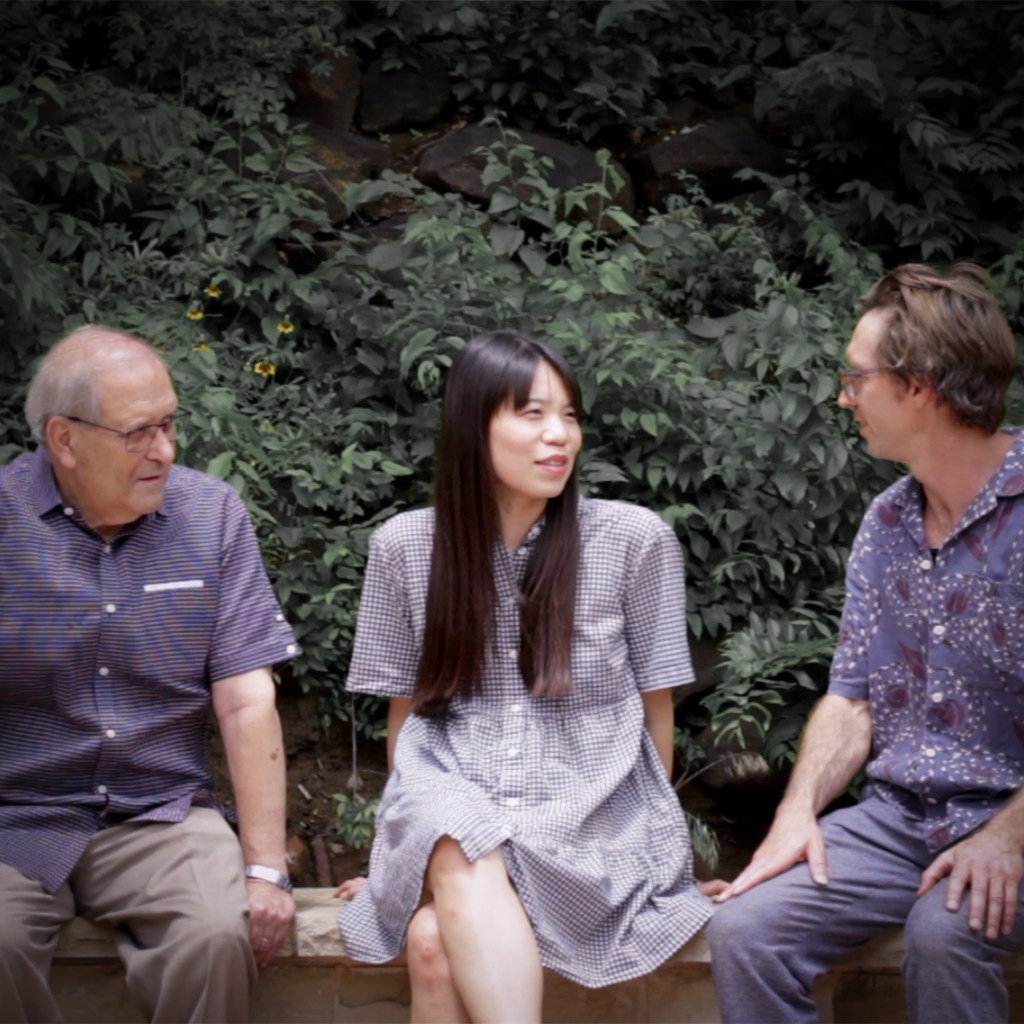
I set up a photo shoot with Steven and Robert for my upcoming recital. I wanted a photo of us having a conversation, to go along with the title of my program.
Wednesday, May 7, 2025 at 1PM in Denton, TX
A: So… I don’t know how to naturally look like we’re having a conversation.
S and R: You just have a conversation!
On performance
[Robert’s been taking an improv acting class in Dallas.]
R: It’s been fun. I’ve gotten a lot out of it. A lot of times I feel like I’m acting. I’m on stage a lot, talking, making stuff up.
S: It’s definitely part of performing. We are actors, and we play different roles in our performances.
A: Yeah, and I feel that’s something we don’t really get trained in.
S: Not much, no. Well, we talk about stage presence, whatever that is.
R: When do you hear about stage presence in music?
S: In juries, that’s one of the things we give a grade for. We tell our students: walk out on stage, look like you’re happy to be there, acknowledge the audience. It’s been awkward on some recitals I’ve seen lately- the performer walks out on stage, the audience claps, they reach the piano. But then they stop clapping, and the performer takes a bow. The timing is a little off…
I guess it’s important to understand what those old customs are communicating between the performer and the audience. When you walk out on stage and bow, it’s like you’re greeting, “Hi, here I am.” And then, after you perform, you are saying “Thank you,” acknowledging the audience as a participant in the performance. If you think of it that way, it becomes much more natural.
A: When I came out of music school, I felt like I was pretty comfortable with classical performing customs, but once I started doing shows in festivals and other types of performances, it was very different. Obviously you don’t do the same thing, but you still have to…
S: You have to connect with the audience somehow.
A: Yeah. And it doesn’t really make sense to be so formal. It’s awkward if you try to transfer that exactly.
S: Well, the concept of it, though- we’re happy to be here, we’re grateful for you, and we hope you enjoy our performance.
Famously, Miles Davis would turn his back to the audience when he was performing, and people thought that was terrible.
A: Oh, really? The whole time?
S: Yeah. He was a very angry human. That was the extreme, and his message was: we’re not playing for the audience, we’re playing for ourselves and for art- a higher purpose. We’re not entertainers.
Do you think of yourself as an entertainer?
R: I do.
A: I do, definitely.
R: That whole bebop history- I’ve heard Charlie Parker and Dizzy Gillespie had that view of things as well.
S: Oh yeah, bebop was a secret language. It had some words- bebop itself was a made up term.
R: The song titles, a lot of them are really hard to comprehend- combinations of words or obscure words.
S: I think that had a lot to do with black culture at the time, getting away from minstrel tradition as entertainers, and claiming artistic validity.
On jazz/classical crossover
R: Did you have any training playing jazz?
S: Yeah, I took lessons and studied with a couple of jazz pianists. I took classes when I was at Indiana University with David Baker. Improvisation, arranging, jazz history. I could have been a jazz major, but that was all extracurricular in terms of my degree. I think I ended up with the record for the most credits for an undergraduate.
It was fun. He was a great teacher. I got to play in the second band, like the 2 o’clock band at UNT. That was cool, because we played published arrangements. Really good stuff like Thad Jones, Bill Holman, really great arrangements. I learned a lot from that too.
Of course, I kept studying on my own, through recordings and transcriptions, and doing the regular work that jazz students do.
R: To me the most well known jazz/classical player is Keith Jarrett, as far as being highly regarded in both. At that time, he was probably a big deal, right?
S: Oh, yeah. I was a fan of Jarrett’s from the early 70s. I should say though that his classical recordings are not highly regarded in the classical world.
I think some of the current crop of pianists are much more respected in both areas. And that’s people like Aaron Deal, Brad Mehldau.
R: Oh yeah, I knew Brad Mehldau played some Bach. I didn’t realize he was really making classical recordings.
S: He did a project where he played the original Bach and then did improvisation based on thematic material from that. It got good reviews. There are a couple more like that- Emmet Cohen is another one, doing a lot of interesting things. So the lines are not so delineated.
R: In my life- outside of UNT, I’ve felt like there’s not a whole lot of delineation among the people I’m around, although I wouldn’t say I’ve ever really been in the classical world. Do you think that’s changed during your career?
S: Yeah, I think it’s changed. The lines that there might have been 40 years ago are disappearing. As I mentioned, there are guys that are doing both. They’re honoring the history of jazz, and doing projects that reflect that evolution. It’s a good time for jazz, I think.
R: My only time at UNT was as a kid, and then I came here for graduate school, but I was so involved with other things, that I never got the “UNT jazz program” mentality. A lot of people I talk to actually view it as a conservative approach to jazz education.
S: Well, that’s changing, too. We have younger faculty, they’re bringing ideas. Dave Meder is a good example- jazz pianist. He can do traditional jazz, but he also has his own language, which is jazz plus classical. He’s writing large form pieces, and I think he’s representative of this new philosophy. It’s not just improv class, learning the changes to Donna Lee or whatever.
Scott Tixier is another example. He’s all over the place- and he wants to do a project with me of playing classical repertoire straight, and then do improvisation. We’re gonna go in the studio sometime, probably sooner than later, and do some recording.
R: Oh, that sounds awesome.
S: I just finished a piece for Scott and a classical violinist- it’s a trio, for two violins and piano, and I called it “When Worlds Collide.”
A: Yeah, you told me about that. So did you find someone to make that happen? Because you said the classical violinist moved.
S: We have another one who’s also interested in this crossover from the classical side. And so we’re gonna probably do some playing over the summer, get some things happening.
On composition
R: So when you started writing stuff that you specifically talked about your jazz influence, like the Bill Evans one- is that different than writing other compositions, for you?
S: I guess I do tend to draw on my background and interests, and my love for different types of music, and I write in different styles for the occasion- and not just jazz. My flute sonata has a lot of French influence, because that was what I played as an undergraduate- accompanying for flute players. I like the sound of the flute and piano the way that the French did it.
A: Yeah, it has a pretty characteristic sound.
S: I wasn’t consciously saying “Okay, I’m going to write a piece in the French style,” but that’s just how it came out.
R: Does improvisation and composition go together for you?
S: Oh yeah. Well, composition is written improvisation. And now, with our current technology, we can do both, right? We can improvise while we’re composing. And you can input pitches directly.
R: So do you have all that midi stuff set up?
S: Oh yeah. You can change the note value with one hand, play with the other hand. It works pretty well.
R: Yeah, I love that. I don’t play keyboard very well, but not having to click on notes makes it a more musical experience. If I could really play, I feel like it would be amazing.
A: I guess you can’t do that on guitar…
R: Well, they have midi guitars- I’m not sure how well they do. I’ve never tried it.
Hey, thank you for coming.
A: Yeah, thanks!
R: I know you’ve thought about this stuff a lot of times, but specifically hearing about it from you is really, really interesting.
S: Well, we should continue our discussions- our dialogues.
R: Yeah, I guess we will, because the recital is in June, right?
A: Yeah, Robert is going to play on Shostakovich and Mancini. In the third movement of Shostakovich, there’s actually a “Hawaiian guitar” (steel guitar) solo.
S: Oh yeah? Crazy, huh?
Dialogues: Between classical and jazz
Friday, June 27, 2025 at 6PM
Blue Mound United Methodist Church, Denton, TX
Free admission, donations appreciated
Alyse Hokamp, flute
Steven Harlos, piano
Robert Hokamp, guitar
Program:
Claude Debussy
Prelude to the Afternoon of a Faun
Steven Harlos
Billiana (trans. flute)
Paquito D’Rivera
Three Pieces for Clarinet (trans. flute)
Dmitri Shostakovich
Suite No. 1 for Jazz Orchestra (arr. flute, piano, guitar)
Henry Mancini
The Pink Panther
Speedy Gonzales

 Alyse Hokamp